
Industry 4.0 Robotics: The New Competitive Advantage
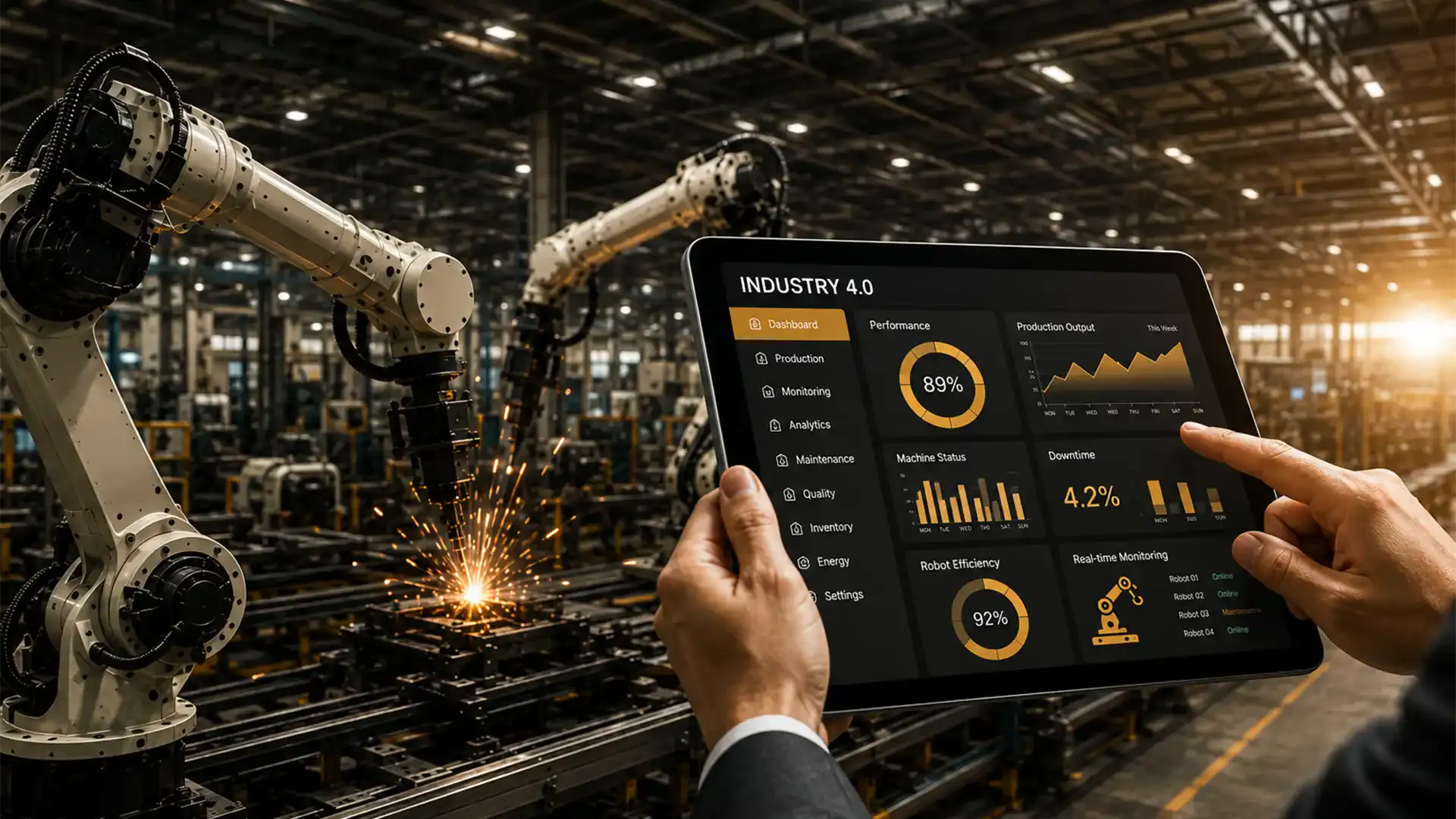
There was a time when investing in robotics was largely a question of affordability. Today, the more pressing question is whether organisations can remain competitive without it. Manufacturers face shorter production cycles. Infrastructure operators are expected to manage ageing assets with tighter budgets. Utility providers must deliver uninterrupted services while meeting stricter safety and environmental standards. Across sectors, operational complexity is rising faster than traditional methods can accommodate. This is the reality that defines Industry 4.0—not simply the adoption of new technologies, but the transformation of how organisations operate, make decisions, and compete. In this environment, robotics has moved well beyond automation. It has become a strategic capability.
Industry 4.0 Is Redefining Industrial Performance
Industry 4.0 is often associated with connected factories, smart sensors, and digital transformation. While these technologies are important, the concept runs deeper.
At its core, Industry 4.0 connects physical operations with digital intelligence. Machines no longer function as isolated assets. They communicate with one another, exchange operational data, support predictive maintenance, and continuously optimise performance.
Robotics plays a central role in this ecosystem because it bridges the gap between digital insight and physical execution.
A sensor can identify an operational issue.
Artificial intelligence can analyse it.
A robot can respond to it.
That integration fundamentally changes industrial workflows.
Why Competitive Advantage Looks Different Today
Historically, organisations competed through scale, labour costs, or production capacity.
Today's competitive landscape rewards different capabilities:
- Operational resilience
- Faster decision-making
- Workforce safety
- Infrastructure reliability
- Asset intelligence
- Sustainable operations
These outcomes depend increasingly on technology rather than traditional operational expansion.
Robotics contributes to each of these priorities by improving consistency, reducing exposure to hazardous environments, and enabling organisations to gather operational data that was previously difficult—or impossible—to obtain.
The result is not simply higher productivity.
It is better organisational performance.
Robotics Is No Longer Limited to Manufacturing
Industrial robots first gained widespread adoption on factory floors where repetitive tasks could be automated with precision.
That model has expanded dramatically.
Today, robotics supports inspection and maintenance across industries such as:
- Oil and gas
- Mining
- Utilities
- Water and wastewater
- Public infrastructure
- Logistics
- Heavy engineering
- Renewable energy
These sectors often involve environments where human access is difficult, hazardous, or inefficient.
Inspection robots navigate confined spaces.
Autonomous systems assess pipelines.
Remote-operated platforms inspect industrial assets without interrupting operations.
Robotics has evolved into an infrastructure technology rather than simply a manufacturing technology.
Data Is Becoming the Real Competitive Asset
Every industrial operation generates information.
Equipment performance, inspection records, environmental conditions, maintenance history, operational anomalies, and asset health collectively create a digital picture of infrastructure performance.
Traditionally, much of this information remained fragmented.
Modern robotic systems collect structured, high-quality operational data during every inspection and maintenance activity.
That information supports:
- Predictive maintenance
- Asset lifecycle planning
- Failure prevention
- Resource optimisation
- Performance benchmarking
- Regulatory compliance
Organisations no longer compete solely through physical assets.
They compete through how effectively they understand those assets.
Safer Operations Create Stronger Businesses
Worker safety has become one of the strongest drivers of robotic adoption.
Industries managing confined spaces, hazardous chemicals, high temperatures, underground infrastructure, or unstable environments increasingly recognise that engineering solutions should eliminate unnecessary exposure wherever possible.
Rather than sending personnel directly into hazardous locations, robotic systems perform inspections, collect diagnostic information, and support maintenance planning from a safe distance.
This approach produces multiple benefits simultaneously.
Safety improves.
Operational disruptions decrease.
Inspection quality becomes more consistent.
Maintenance planning becomes more accurate.
Engineering innovation creates business value by reducing operational risk.
Industry 4.0 Demands Organisational Readiness
Technology alone does not create competitive advantage.
Successful Industry 4.0 adoption requires organisations to rethink operational processes alongside technological investments.
This includes:
- Digital asset management
- Workforce upskilling
- Cybersecurity
- Data governance
- Predictive maintenance strategies
- Cross-functional collaboration
Companies that approach robotics as a standalone purchase often achieve incremental improvements.
Those that integrate robotics into broader digital transformation strategies unlock far greater operational value.
Competitive advantage emerges from connected systems rather than isolated technologies.
Engineering Innovation Is Expanding What's Possible
The evolution of robotics is no longer driven solely by larger multinational manufacturers.
Engineering-led innovators are developing specialised robotic platforms tailored to complex industrial applications where conventional automation cannot easily operate.
This has created opportunities for companies focused on solving infrastructure-specific challenges through advanced robotics, artificial intelligence, machine vision, and intelligent sensing technologies.
One example is Genrobotics, whose work demonstrates how indigenous engineering can apply robotics to hazardous public infrastructure environments. Their approach reflects a broader shift within Industry 4.0—developing technologies that combine mechanical engineering, digital intelligence, and human-centred design to solve operational problems with measurable impact.
The growing contribution of such innovators illustrates that competitive advantage increasingly belongs to organisations capable of applying robotics beyond traditional factory automation.
From Automation to Strategic Decision Support
One of the most significant changes brought by Industry 4.0 is the evolving role of robots.
They are no longer viewed solely as machines that perform physical work.
They are becoming intelligent platforms that gather operational intelligence, support engineering analysis, improve asset visibility, and enable more informed decision-making.
Every inspection contributes data.
Every maintenance activity strengthens future planning.
Every autonomous operation improves organisational understanding of infrastructure performance.
This shift transforms robotics from an operational expense into a long-term strategic investment.
The Organisations That Adapt First Will Shape the Next Industrial Era
Every industrial transformation creates new market leaders.
Not because they adopted technology first, but because they understood its broader implications before others did.
Industry 4.0 is creating precisely that opportunity. Robotics is no longer a symbol of technological ambition or modernisation—it has become a practical tool for improving resilience, strengthening safety, enhancing infrastructure intelligence, and enabling faster, better-informed decisions across industrial operations.
As global competition intensifies, organisations will increasingly be measured by how effectively they combine engineering expertise with intelligent technologies. Those that view robotics as a core business capability rather than an isolated automation project will be better positioned to respond to uncertainty, optimise performance, and create lasting operational advantage.
In the years ahead, the defining feature of successful industries may not be the size of their facilities or the scale of their production. It may be their ability to deploy intelligent machines that help people work smarter, protect critical infrastructure, and continuously improve the way complex systems operate.
Related Blogs

Hazardous-Environment Robotics: Where Physical AI Meets India's Sanitation and Refinery Safety Crisis
At the India AI Impact Summit 2026 in New Delhi, EY India demonstrated “Scout,” a companion robot combining digital twins, robotics, and physical AI to help refinery workers track hazardous pipeline alerts that overwhelm small monitoring teams. It's a compelling demo. But in India, this isn't a preview of the future — it's already a deployed industry, with a body count that makes the case for it.

India’s Robotics Revolution: Innovation Beyond Software
For much of the past two decades, India's innovation story has been synonymous with software. The country became a global technology powerhouse by building expertise in IT services, digital platforms, and enterprise software. That legacy remains a remarkable achievement, but a quieter transformation is now taking shape—one driven not by code alone, but by machines capable of interacting with the physical world. This shift marks the rise of next-generation robotics, where engineering, artificial intelligence, advanced electronics, and intelligent sensing converge to solve problems that software alone cannot address. As industries modernise and infrastructure grows more complex, India's next wave of innovation is increasingly being built in laboratories, manufacturing facilities, and robotics research centres.

Scaling Deep-Tech Innovation: From Research to Commercialisation
Brilliant engineering ideas rarely fail because they lack technical merit. More often, they struggle to cross the difficult bridge between laboratory success and large-scale deployment. Building a working prototype is an achievement. Transforming that prototype into a reliable product that industries trust, regulators approve, and customers adopt is an entirely different challenge. This transition is where every deep tech startup is tested. Unlike software ventures that can iterate rapidly with minimal physical constraints, deep-tech companies must navigate complex engineering, manufacturing, certification, funding, and market adoption simultaneously. As India strengthens its innovation ecosystem, the ability to commercialise advanced technologies may become just as important as inventing them.